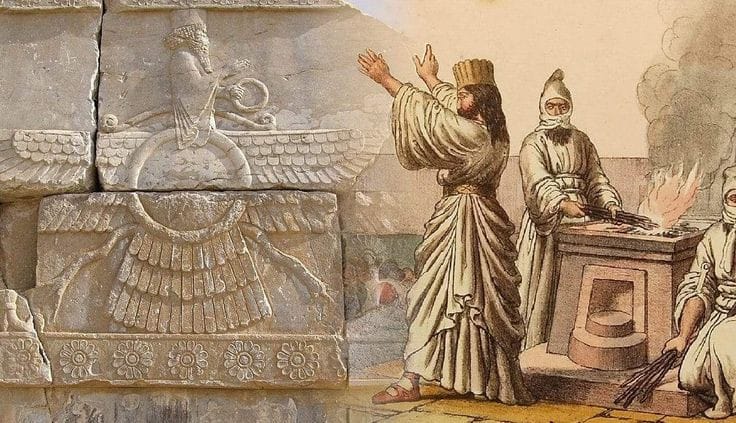
Zoroastrianism, also known as Mazdaism, is an ancient Aryan religion believed to have originated around 3500 years ago or, according to some traditions, 2500 BCE in Persia. It is generally called Zoroastrianism. Although its followers are very few ; fewer than 130,000 worldwide. It is one of the world’s oldest religions. An Iranian prophet named Zoroaster (Zarathustra) founded the religion, which is also known as the Parsi religion, and sometimes referred to as the religion of fire worshipers or Magi.According to Zoroastrian sacred texts, the “Dastur,” the attributes of God are as follows:
- God is one.
- He has no equal.
- He is without beginning or end.
- He has no father, son, wife, or offspring.
- He is incorporeal and formless.
- No eye can encompass Him.
- No mental faculty can conceive Him.
- He is beyond all that humans can imagine.
- He is closer to us than we are to ourselves.
Zoroastrian beliefs that require faith include:
- Prophets
- Divine revelation (Sraosha)
- Angels (Yazads)
- The end of the world
- The Day of Judgment
- Life after death (Aakhirat)
- Heaven and Hell
- Concept of life after death
- Ahriman (Satan)
- Daevas (Jinn)
- Five daily prayers (Yesna)
- Mandatory charity (10%)
- The coming of Saoshyant (Messiah/Mahdi)Vohu Manah,
- A chosen angel (Gabriel)
Concept of Heaven and Hell:
Zoroastrianism was the first religion to articulate the concept of heaven, hell, and a single God.
Resurrection and Judgment:
Zoroastrianism envisions the world’s end similarly to Islam, including a scale balancing good deeds and sins to decide one’s fate in heaven or hell.
Names of God:
Zoroastrianism believes in multiple names of God, having 101 names in their tradition
Five Daily Prayers:
Zoroastrianism prescribes five prayers daily, divided into five parts of the day:
Havand Gah (Fajr): from 36 minutes before sunrise to 12:39PM
Rapithwan Gah (Zuhr): 12:40 PM to 3:39 PM
Uzirin Gah (Asr): 3:40 PM to 36 minutes after sunset
Ushtaran Gah (Maghrib): 72 minutes after sunset to 12:39 AM
Ushahin Gah (Isha): 12:40 AM onwards
Wudu (Ablution):
Like islam, before praying, washing the face and limbs is mandatory.
Angels:
Unlike Judaism, which traditionally does not emphasize angels or similar beings, Zoroastrianism was the first religion to conceptualize angels.
Mi‘raj Event:
A story paralleling the Islamic Mi‘raj exists in the Zoroastrian “Arda Viraf” text, wherein the prophet Viraf rides a half-flying horse-half-human angel to meet God, who grants him the gift of five daily prayers. Exactly as in Islam
Bridge of Judgment (Sirat):
The Zoroastrian belief holds that after death, everyone must cross a bridge (Chinvat Bridge). If one is wicked, the bridge narrows and they fall into hell; if righteous, the bridge expands and leads to paradise. That parallels with Islamic Pull-e-Sirat
The Purgatory-like Place (Ma‘qam al-A‘raf):
Zoroastrianism contains a place called Hamistagan for souls whose good and bad deeds are balanced.