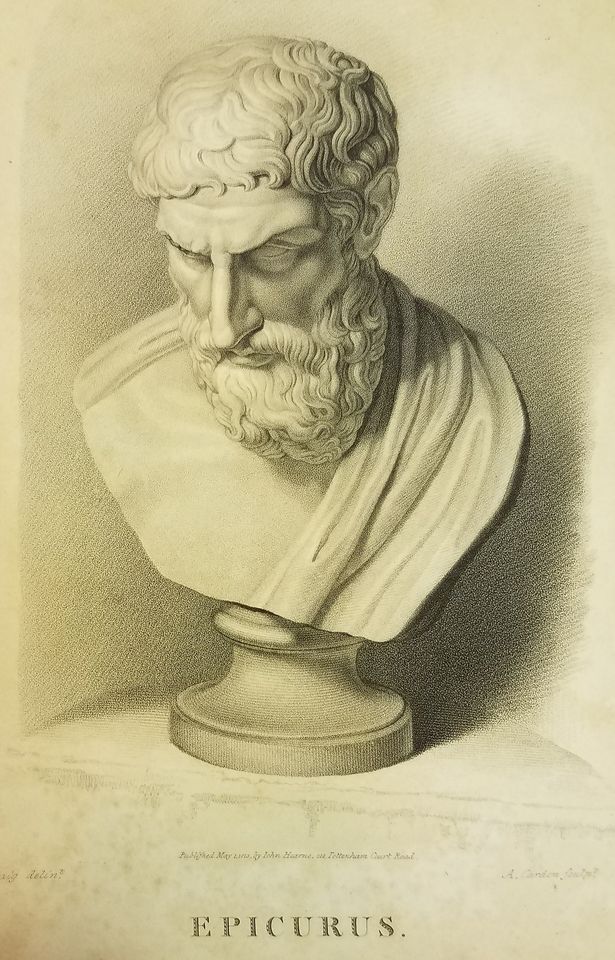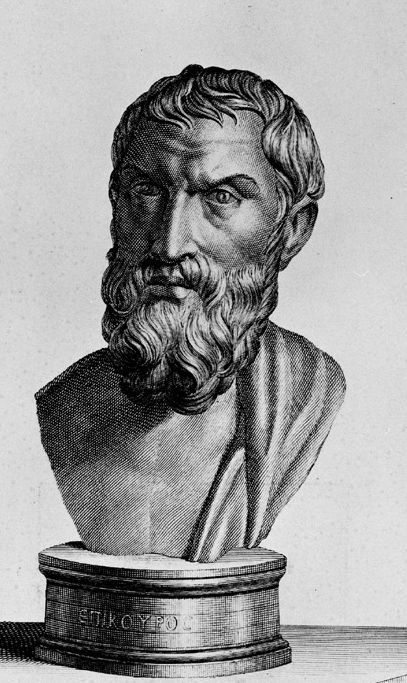
Previously we discussed Epicurean ethics, and as I mentioned, his hedonism was a systematic hedonism with a proper metaphysical/epistemological framework. Because he had a huge influence on 17th-century philosophers for which he doesn’t have much recognition, I thought of writing on it. So today, we’ll look into his metaphysics along with his notion of the soul and his theory of sense perception… Later on in the next part we’ll cover his epistemology, Cosmology and his Conception of society and justice,
Influence :
He had influence of democritus (pre-socratic). As we know, all the pre-Socratics focused on knowing what basic element or elements the universe was composed of. For example, for Thales it was water, etc. So Democritus thought that the universe is composed of tiny indestructible particles he called “atoms.” And the universe as we see it now, came into being by collisions of atoms. Democritus argued that atoms move according to strict necessity, following predictable causal chains. The problem in this for Epicurus was that it would eliminate human freedom..
Distinction of primary and secondary qualities:
Epicurus thought that the universe consists entirely of two fundamental realities: atoms (atoma) and void (kenon). Atoms possess only the primary qualities ie, size, shape, weight, while all other properties (secondary qualities) emerge from their arrangements and movements.. this distinction influenced John Locke for his theory of sense perception in late 17th century..
Metaphysics:
Epicurus adopted atomist framework from Democritus and made crucial modifications to address philosophical problems with strict determinism.. Epicurus introduced a modification to Democritean atomism through the doctrine of the “swerve” (parenklisis). While Democritus proposed that atoms move in perfectly predictable patterns, Epicurus argued that atoms occasionally deviate randomly from their expected path. This atomic swerve serves two essential functions in the Epicurean system.
First, it explains how atoms initially came together to form larger structures. Without some random motion, atoms would fall eternally in parallel lines through infinite void, never colliding to create the complex arrangements we observe in nature. Second, the swerve preserves human freedom and moral responsibility by introducing an element of indeterminacy into the causal structure of the world. As one scholar explains, “Epicurus argued that the swerve…was also what accounted for humanity’s free will; if it were not for the swerve, humans would be subject to a never-ending chain of cause and effect”
Epicurus, like all other greeks thought that these atoms are eternal because of the classic greek notion of ” Ex nihilo, nihil fit” “out of nothing, nothing comes”..
On human soul:
As we know he proposed a mechanistic explaination of the universe, his conception of the Soul would be same, he believed that the soul is composed of perfectly round atoms and they smoothly leave from the body when we die hence he viewed soul as life not as immaterial entity like Plato did…