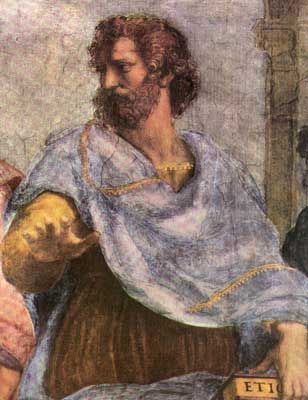
Aristotle didn’t believe in an anthropomorphic god as the Judeo-Christian/Abrahamic god but rather a deistic god. He thought of him as the unmoved mover by virtue of whom the particulars possess motion. His premises were:
Premise 1: Everything in motion requires a mover.
Premise 2: An infinite regress of movers is impossible.
Conclusion: Therefore there must be a first mover that itself is unmoved.
So, according to Aristotle, this unmoved mover isn’t personal, neither the creator of the universe, as he believed the universe to be eternal (ever-existing). He doesn’t describe ex-nihilo creation but describes God as the final cause (telos) of particulars.
The reason of his account was: to be an efficient cause (creation ex nihilo), one must exert the force, and to exert force, one must go through change. But Aristotle viewed God as pure actualization without any potentiality, as he believed that for every process of change to occur, it must undergo from potentiality to actualization of that potential. So he believed God doesn’t go through change, as going through change requires actualization of the potential. Hence That unmoved mover is not a “personal”or “creator” god (since Aristotle holds the cosmos eternal), but rather the final cause or telos: it is the ultimate object of all striving and change, not an efficient cause that produces things by exertion of force.. It is also the final cause of celestial motion: it draws everything toward itself by being the perfection that all things desire.
Furthermore, he believed God contemplates on his own thoughts, as to contemplate on something else, one must perceive something for instance, get input of some kind and again, to get input requires actualization of potential. So God contemplates his own contemplation.