The idea of absolute time, ie; time as a straigh, continuous line moving from yesterday to today and then to tomorrow Roots back to Aristotle. Both Aristotle and Newton believed in absolute time. That is, they believed that one could measure the interval of time between two events, and that this time would be the same whoever measured it, provided they used a good clock.Einstein’s Theory of Relativity revolutionized our understanding of the universe. Einstein first published his theory of special relativity in 1905, but it didn’t gain widespread recognition within the scientific community by the 1920s.
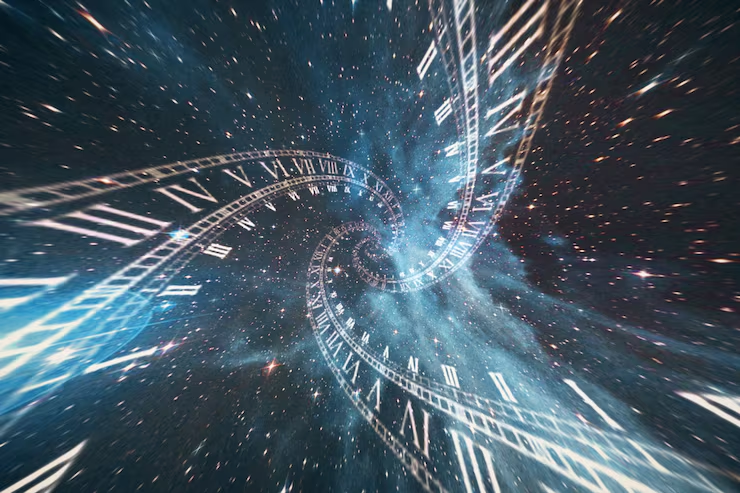
The Theory of relativity revealed that time and space are not separate entities but are interconnected, it demonstrated that whether you are on Earth, another planet, or in a distant corner of a galaxy, you are always confined within the realm of “space-time.” Space-time is a flexible system in which we move, and when you shift positions within it, not only does your location change, but the passage of time also alters for you. To grasp this concept better, imagine space-time as a flexible sheet. Just as placing a heavy stone on the surface of water creates ripples, massive celestial bodies like the Earth, the Sun, or black holes create distortions in space-time. This curvature is what we refer to as “gravity.” In the simplest terms, gravity is the bending of space-time caused by massive objects. Now, this raises the question: what is time? Is time an absolute entity that flows at a uniform rate everywhere? In reality, it is not. The flow of time depends on where you are and the environment around you. The stronger the gravitational pull, the slower time flows. For example, time on Earth flows at a particular rate, but if you were near a black hole, time would slow down. Near a black hole, where gravity is so intense that even light cannot escape, a single moment there could be equivalent to several years on Earth. Which is known as “TIME DILATION”