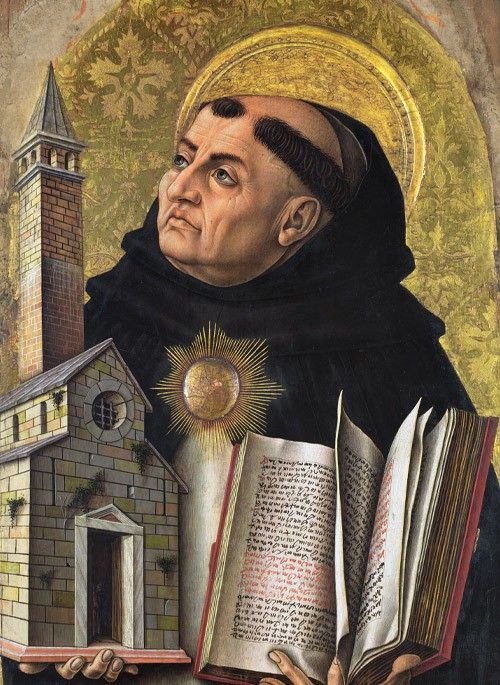
Saint Thomas Aquinas (1225-1274) presented five philosophical arguments to prove God’s existence in his work Summa Theologica. These arguments, known as the “Five Ways” (Quinque Viæ), rational proofs for existence of God
1. The Argument from Motion:
The first argument is based on the principle of motion. Things in the world are in motion or are changing. Aquinas explained motion in terms of aristotelian “potentiality” and “actuality” , meaning that things move to reach their full reality.A moving object is something that has been set in motion, and a mover is something that causes motion to begin. Every moving thing must have a mover behind it. Aquinas asks: where does this motion come from? Nothing can be the cause of its own motion; one thing’s motion begins because of another thing. If we trace this chain backward, there comes a time when this sequence would continue infinitely, which we call infinite regress. Therefore, this motion must have originated from a being that is not itself in motion, and that being is God.
Premise 1: Things are in motion
Premise 2: Things in motion cannot move themselves
Premise 3: Things are moved by other things that are already in motion
Premise 4: Motion cannot regress infinitely backward
Conclusion: There must be an unmoved first mover, which is God
2. The Argument from Efficient Cause:
The second argument is based on the principle of cause and effect. Every thing or event has some cause or reason behind it that brings it into existence. For example, the cause of rain is clouds. If we begin searching for the cause of everything, there comes a time when this sequence continues infinitely. Here we feel the need for a first cause that is not itself the effect of anything else and THAT first cause is God. Aquinas argues that nothing can be the efficient cause of itself, because then it would have to exist before itself, which is impossible. In any ordered series of efficient causes, if there is no first cause, there can be no intermediate or ultimate effects. Since effects clearly exist, there must be a first efficient cause, which everyone calls GOD
3. The Argument from Possibility and Necessity:
This argument is based on the principle of possible and necessary things. The central point of this argument is that most things around us are such that they come into existence with time and are destroyed. These are called “possible” because their existence is possible and their non-existence is also possible.For example, trees, mountains, and other creatures exist for some period of time and then perish after a while. If everything is possible; suppose you don’t exist, I don’t exist, trees don’t exist, and so on; then there could have been a time when nothing existed at all. Therefore, the existence of a necessary being is essential that exists at all times, and this being is God.Aquinas distinguishes between contingent beings (which depend on external factors for their existence) and a necessary being (which must exist and cannot fail to exist). If all beings were contingent, there would have been a time when nothing existed, making current existence impossible.
4. The Argument from Degrees of Perfection
This argument is based on the different degrees or standards of various things. The foundation of this argument is that we see different things around us in different degrees of beauty, power, or goodness. For example, some things are beautiful, some are more beautiful, and some are most beautiful. Similarly, we recognize degrees of power and goodness.When we call something perfect or best, we must necessarily have a standard or measure with which we can compare it. The concept of perfect or supreme only makes sense to us when we have an idea of that standard. That supreme standard or measure is God, who is the highest and most perfect.Aquinas argues that varying degrees of qualities like goodness, truth, and nobility imply the existence of something that possesses these qualities to the maximum degree. Just as fire, being the maximum of heat, is the cause of all hot things, there must be something that is the cause of all being, goodness, and perfection and this we call God.
5. The Teleological Argument
The fifth and the last argument is based on the.Aquinas argued that natural things lacking intelligence act toward specific ends or purposes, and this is evident from their consistent behavior in achieving optimal results. Since unintelligent things cannot direct themselves toward their ends, they must be guided by some intelligent being endowed with knowledge just as an arrow reaches its target through the archer’s guidance. This intelligent being that directs all natural things to their ends is God